
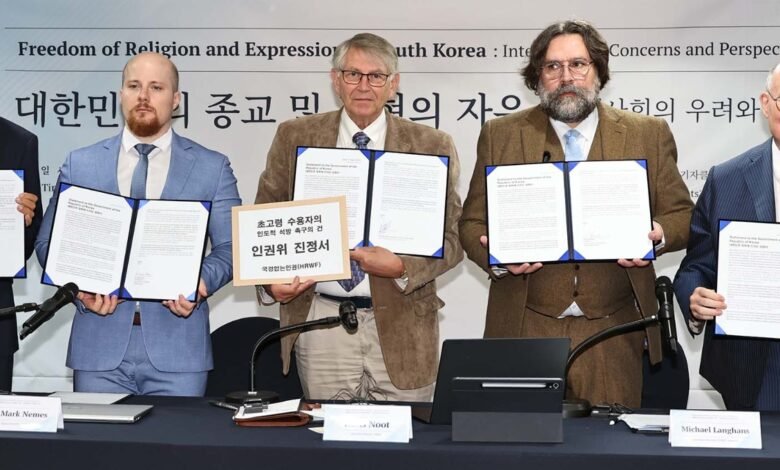
SEOUL, South Korea: Human Rights Without Frontiers (HRWF), together with CAP Liberté de Conscience (CAP LC), which has accredited ECOSOC status at the United Nations, FOREF, CESNUR and Bitter Winter, held a press conference today at the Seoul Foreign Correspondents’ Club on Freedom of Religion or Belief and Freedom of Expression in South Korea. The issues addressed included concerns about the treatment of elderly religious leaders in pretrial detention, including questions of proportionality, humanitarian considerations, and due process. The organizations called on South Korean authorities to review the detention of 95-year-old Shincheonji Chairman Lee Man-hee and to ensure that the legal and administrative response to religious minorities remains neutral, proportionate, and consistent with South Korea’s international human-rights obligations, including with respect to 83-year-old Mrs. Hak-ja Han Moon of the Family Federation.
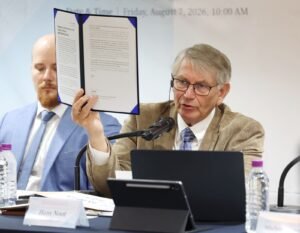
The issues discussed today form part of a broader pattern of Freedom of Religion or Belief concerns in South Korea. Concerns have also persisted regarding Segero Church in Busan, which has reportedly continued to face harassment and official scrutiny even after Pastor Son Hyun-bo was released from detention.
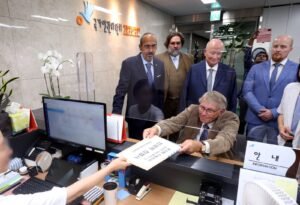
Reporting has also raised questions about conscientious objection, public hostility toward a mosque project in Daegu, and religious accommodation in educational settings. Over the past decades, HRWF has documented the imprisonment of hundreds of Jehovah’s Witnesses in South Korea as conscientious objectors, and although alternative civilian service was later introduced, critics maintain that it has been implemented in a punitive manner rather than as a genuine rights-respecting alternative, notably because it requires 36 months of service in correctional facilities, twice the length of regular military service. Recent court decisions have also upheld key features of that system against constitutional challenge.
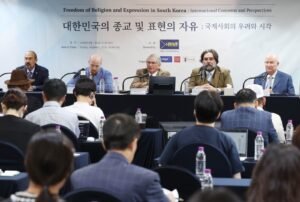
Opening the conference, Hans Noot, Associate Director of HRWF, said the issues at stake “lie at the heart of democratic society,” warning that when religious communities are stigmatized, peaceful gatherings are restricted, and dissent is treated as a problem to be contained, the consequences “extend far beyond any single group or case.” He said the conference was not about defending any one theology or movement, but about “defending a principle: that fundamental rights apply equally to all.”
Thierry Valle, President of CAP Liberté de Conscience, addressed the legality of Chairman Lee’s detention under international law. Referring to South Korea’s ratification of the International Covenant on Civil and Political Rights in 1990 and the Convention against Torture in 1995, he questioned whether placing a 95-year-old in pretrial detention is consistent with those obligations. He stressed that the presumption of innocence must prevail over any presumption of guilt.
There are alternative more proportionate and more humane measures respecting the presumption of innocence and human dignity in democratic countries. And he cited precedents including Cardinal Joseph Zen’s 2022 release on bail in Hong Kong and Vietnam’s decision to place Buddhist Patriarch Thich Quang Do under house arrest rather than in prison.